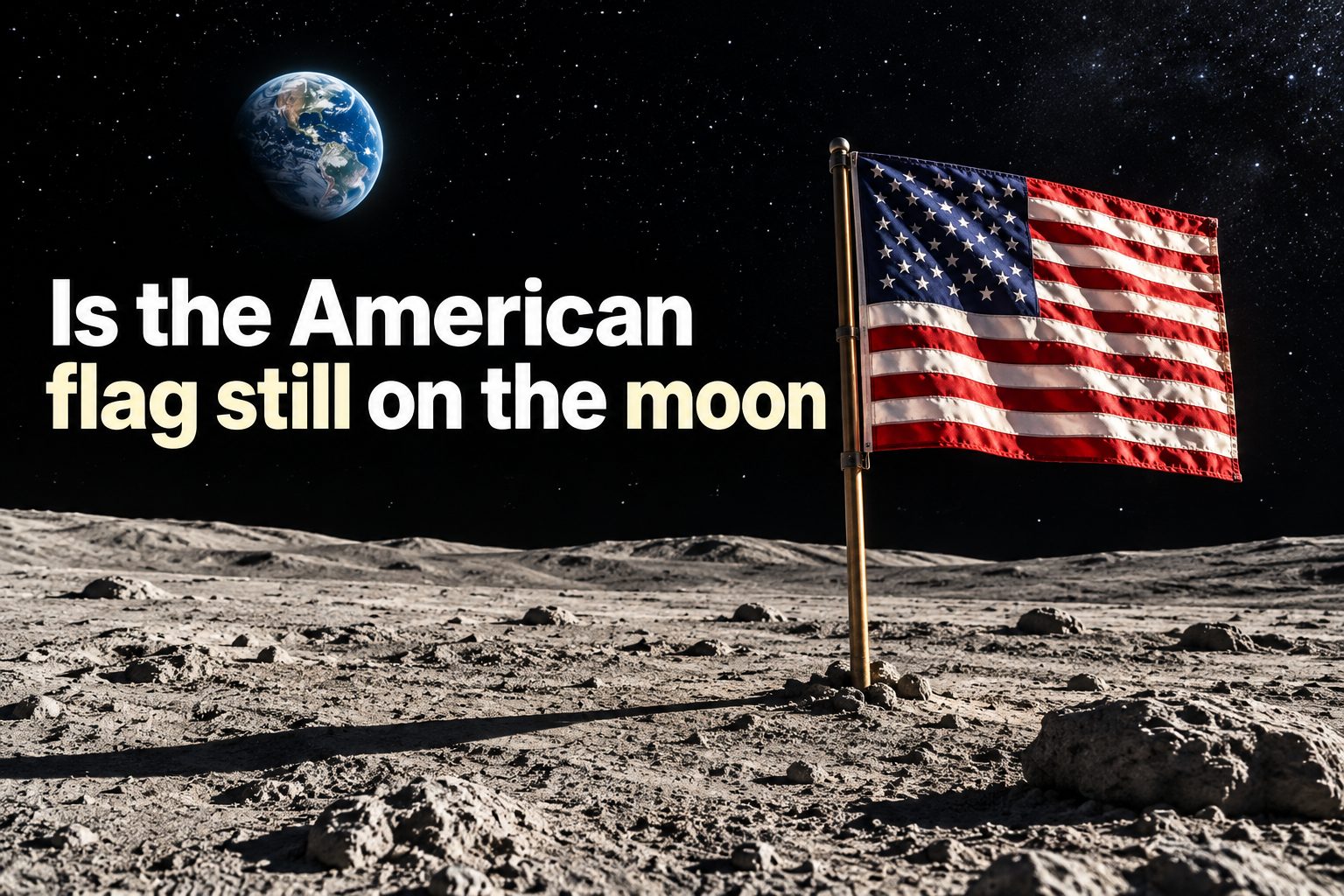
Is the American flag still on the moon? Yes, six American flags were planted during Apollo missions, and they are believed to remain at their landing sites. The bigger question is whether they still look anything like the bright flags seen in historic photographs.
The flags are powerful symbols of the Apollo program, but the Moon is an unforgiving place. Extreme temperatures, radiation, dust, and the vacuum of space have likely changed their appearance dramatically over the decades.
This article explains what happened to the lunar flags, why they were left behind, what modern spacecraft observations can confirm, and which popular claims about them are inaccurate.
Apollo astronauts planted flags during six successful Moon landings between 1969 and 1972. The missions were Apollo 11, 12, 14, 15, 16, and 17, and each crew left a flag near its lunar module.
The Apollo 11 flag was placed close to the lunar module. When the astronauts launched from the Moon, the engine exhaust may have knocked it over, which is why later observations do not clearly show it standing.
The other five flag locations show evidence of shadows and objects consistent with flagpoles still standing. These observations come from spacecraft imaging rather than close-up inspection by people on the surface.
A flag on the Moon does not wave because there is almost no atmosphere. In video footage, movement came from astronauts handling the pole and from a horizontal support rod that held the fabric open.
The flags matter because they represent exploration, engineering achievement, and an era of intense scientific effort. They are not proof of ongoing human activity on the Moon, but they remain part of the historical landscape.
Why Are Apollo Flags Still on the Moon?
Apollo Mission Heritage
The flags were left as part of the Apollo missions' physical record. Astronauts needed to reduce weight before returning to orbit, so items that were no longer necessary, including flags, were left on the lunar surface along with experiments, equipment, and mission hardware.
No Weather to Remove Them
The Moon has no rain, wind, oceans, or growing plants that would quickly carry away or cover objects. A flagpole can remain in place for a very long time, although micrometeorites and lunar dust slowly alter the area over much longer periods.
Extreme Sunlight Damage
The fabric has likely suffered severe damage from unfiltered sunlight and radiation. On Earth, ultraviolet light fades fabrics over time. On the Moon, there is no atmosphere to filter much of that radiation, so the colors probably faded quickly.
Lunar Temperature Changes
A lunar day and night create enormous temperature swings. Materials expand and contract repeatedly under those conditions. The flags, poles, stitching, and fasteners were not designed to remain visually perfect through decades of repeated thermal stress.
Vacuum Does Not Preserve Color
Space vacuum can slow some forms of decay because there is no oxygen or moisture for ordinary rust, mold, or rot. However, vacuum does not protect fabric from radiation, temperature cycling, and impacts from tiny particles moving at high speeds.
A Lasting Historic Site
The landing areas are widely treated as historic places even though they are far from Earth. The flags are part of a larger collection of Apollo artifacts, including footprints, descent stages, rover tracks, scientific instruments, and discarded mission supplies.
What Evidence Shows the Flags Remain?
1. High-resolution orbital images show the Apollo landing sites and reveal shadows consistent with upright flagpoles at several locations.
2. The Lunar Reconnaissance Orbiter has photographed descent stages, rover tracks, and other surface features near the flag locations.
3. Astronaut accounts confirm that every Apollo crew except Apollo 11 saw its flag standing as the lunar module departed.
4. The Apollo 11 flag was probably blown down by the ascent engine plume, making it a special case rather than evidence that all flags disappeared.
5. No later crew has visited the Apollo sites closely enough to inspect the fabric, so claims about the flags' exact condition should remain cautious.
What Happened to the Flag Colors?
- Ultraviolet Radiation: Strong solar ultraviolet radiation likely broke down the dyes and fibers, causing the red and blue areas to fade substantially.
- Solar Particle Exposure: Charged particles from the Sun can damage exposed materials over time, especially when there is no atmosphere or magnetic protection around the Moon.
- Thermal Cycling: Repeated heating in sunlight and cooling in darkness can weaken fabric, threads, and attachment points across many lunar day-night cycles.
- Micrometeorite Impacts: Tiny impacts may puncture or fray the material gradually, even though the odds of a single large impact destroying a flag are low.
- Lunar Dust: Dust disturbed during landing or launch can settle on nearby objects and make a flag look duller or less recognizable from a distance.
- Unknown Present Appearance: Scientists cannot state exactly what each flag looks like today because no close-up inspection has been performed since the Apollo missions ended.
Which Moon Flag Claims Are Misleading?
Flags Do Not Wave in Wind
A common misconception is that flag movement in Apollo footage proves wind was present. The Moon has essentially no atmosphere. The apparent motion came from astronauts twisting the pole, handling the fabric, and the flag's support bar retaining movement briefly.
They Were Not Made to Last Forever
The flags were ceremonial mission items, not permanent space-grade monuments designed for centuries of exposure. Their presence is historically important, but it should not be assumed that the fabric remains whole, colorful, or easily recognizable today.
Orbiters Cannot See Fine Fabric Detail
Orbital cameras can identify landing hardware, tracks, and shadows, but they cannot provide a close visual reading of the cloth. A visible shadow can support the conclusion that a pole stands there without proving the flag itself is intact.
The Flags Are Not Ownership Markers
Planting a flag did not give the United States ownership of the Moon. International space principles reject national appropriation of celestial bodies. The flags were symbolic expressions of achievement and national identity, not legal land claims.
Apollo 11 Is Different
The first flag is widely believed to have fallen during Apollo 11's departure. Neil Armstrong and Buzz Aldrin placed it very close to the lunar module, and the ascent engine's force likely disturbed it when the crew lifted off.
Moon Objects Change Slowly
It is also misleading to say lunar artifacts never change. They change far more slowly than many objects on Earth, but radiation, impacts, dust movement, and temperature stress continue to affect them over time.
The American flags left by Apollo astronauts are still on the Moon in the sense that the poles, locations, and at least some flag-related hardware remain part of the Apollo landing sites. Evidence strongly suggests that five poles may still stand, while the Apollo 11 flag likely fell during departure.
What is uncertain is the condition of the fabric. Decades of sunlight, radiation, extreme temperatures, dust, and tiny impacts probably faded and weakened the original nylon flags beyond recognition.
The lasting value of the lunar flags is historical rather than decorative. They remind us of a period when human exploration reached another world and left behind evidence that can still be studied today.
FAQs About the American Flag on the Moon
Is the American flag still on the Moon?
Yes, the six Apollo flags were left on the Moon, and the available evidence indicates that flagpoles or related hardware remain at the landing sites. The Apollo 11 flag likely fell over during liftoff, while shadows suggest several later mission poles are still upright.
How many American flags are on the Moon?
Six American flags were planted during the Apollo 11, 12, 14, 15, 16, and 17 missions. Each successful Apollo Moon landing crew placed one near its lunar module before beginning other surface activities and returning to orbit.
Are the flags still red, white, and blue?
Probably not. Scientists expect intense solar radiation to have faded the colored dyes and weakened the nylon fabric. The flags may appear pale, gray, brittle, torn, or largely reduced to fragments, but no one has inspected them closely since the Apollo era.
Why does the flag look like it is waving in Apollo video?
The Moon has no meaningful wind, so the flags did not wave in air. Motion occurred when astronauts handled the pole and fabric. A horizontal support rod kept the flag extended, and the material continued moving briefly after being disturbed.
Can satellites see the flags on the Moon?
Modern lunar orbiters can photograph Apollo landing areas and identify larger equipment, tracks, and shadows. Their images cannot show detailed fabric condition. They provide useful evidence that objects remain at the sites, but not a close-up view of each individual flag.
Do the lunar flags mean the United States owns the Moon?
No. The flags were symbolic and did not establish ownership. International space law does not allow a country to claim the Moon or another celestial body as national territory. The Apollo sites are historically significant locations, not American land.